Monday, September 16, 2013

Religion, Evolution and Transcending Oneself

In order to appreciate fully the depth of the questions from last class (I've posted them below to be perfectly clear) it's necessary to add some information and some ideas to your thinking.  Here's a TED talk by John Haidt about Religion and Evolution.

And here are the five questions that you are grappling with from last class.

The Religious Impulse?
1. Explain the evolution of religion.  Define your terms as you use them, e.g. “religion”.

2. Explain why the features of religion that makes it such a powerful force in human history.

 3. Does practicing a religion develop an advantage from a Darwinian standpoint (i.e. an advantage in competition for resources, selective advantage, survival of the fittest)?

4.       How is religion an adaptation to circumstances (think Darwinism again)?

5.      Explain an example of looking at the natural history of a religion.

Here are some notes from the TED talk today - ideas to consider when addressing the questions above....

a1. There is evolutionary evidence of a human need for self transcendence.  

2. 2. One of the earliest bits of evidence for this is collective joy/grief that we see today - this will likely have occurred throughout human history.

 Transcending our own existence takes us from the basics of human life (needs on earth) to "spiritual" or higher needs that we possess, e.g. the need to belong to something bigger than ourselves.

   Self-interest diminishes, the collective good takes on more meaning.

  The big question remains, "How could it possibly be healthy for us to lose ourselves for a greater cause, e.g. die in war, give money to charity.

  Culture arose - culture is the complete set of learned human behaviour patterns.

\  Often transcending oneself requires that we lose our individuality and become part of a greater collective drive/goal/outcome/pursuit.


Friday, September 13, 2013

The Religious Impulse?

Yesterday we finished the reading and then visited the cafe for Team / Club day.

Today you can finish your work on the reading and then address these questions about the religious impulse in humans - after all, 85% of people practice a religion.

The Religious Impulse?
1. Explain the evolution of religion.  Define your terms as you use them, e.g. “religion”.

2. Explain why the features of religion that makes it such a powerful force in human history.

 3. Does practicing a religion develop an advantage from a Darwinian standpoint (i.e. an advantage in competition for resources, selective advantage, survival of the fittest)?

4.       How is religion an adaptation to circumstances (think Darwinism again)?

5.      Explain an example of looking at the natural history of a religion.

Wednesday, September 11, 2013

Thinking Critically About Beliefs . . . or are they Facts?


Let's have a look at your Brain on "Delude" - Ted talk on illusions.

Let's have a lookie at this Ted Talk about "Why People Believe Weird Things." 


Today we discussed the New York Times Article, "It's a “Fact”: Faith and Theory Collide Over Evolution."  and you are responsible for doing some good critical thinking on it.  We'll finish this tomorrow.


Tuesday, September 10, 2013

Why Practice?

Fun Intro Video
The Music That I Played for the Video (Chopin's Fantasie Impromptu)

The Hubble Deep Field View of the Universe:
This photo was taken over the course of several days from the Hubble Space Telescope in 1995.  It depicts a part of the sky previously thought to be quite empty except for a few faint starts in the Milky Way.  What it depicts, and this surprised astronomers at the time, is that a tiny part of the sky, 1/24,000,000th of the Northern Hemisphere's night sky, or about the size of a tennis ball held out 100m away, actually contains about three thousand of galaxies dating back to a billion years after the big bang.  They took a similar photo of the Southern Hemisphere and discovered that it, too, had 3,000 galaxies supporting the theory that the universe is uniformly populated by galaxies - and the further away they are the older they are.


Why do People Practice Religion?

Most people feel that there is a realm beyond their own physical reality.  Something beyond our five senses.  Because we can't verify what that other reality is we have a need to "verify" that other reality through faith.

FEAR - some are concerned that after they die they might end up somewhere not so nice, so through their belief they believe they'll end up in heaven.  Look up "Pascal's Wager."
One of our natural human tendencies (part of our Human Nature) is to maintain deep seated fears that our ancestors held.  We have insecurities about being alone, death, doing the wrong thing, sickness, disease, sadness and hopelessness.  We fear the power of nature and our small position in it.

WONDER - nature remains quite mysterious for most people.  Many things in nature that are not explainable through our current understanding are called "miracles."  This is used as evidence of the "super" natural.  Is it all random or is it carefully designed by a higher being?  For some people what remains poorly explained by science is explained through spirituality.

QUESTIONING - many people will not accept that their existence is limited to their time on earth.  Few of us want to go through life alone and we certainly do not want to face death alone.  Most of us do not accept that chance rules out lives - rather we want to control our destiny through free will and perhaps with the intervention of a God or higher power.

IDENTIFY - is it enough to be identified with a label that's relevant only here on earth?  Labels like,
student
sibling
friend
athlete
worker
rocker
skater
jock
etc.
For most people something more long-lasting and meaningful is necessary and they find that in spirituality.

INTUITION - many of us feel unfulfilled by our material wealth.  Even though we have dominated the earth we still do not feel fulfilled (U2's "Still Haven't Found What I'm Looking For" for example).  Many religions were founded by inspired leaders who had ideas about a different and improved reality.

BIG QUESTIONS - most people are curious about big questions in life, many of which we have already referred to . . .
Who am I?
What is right and wrong?
Why are we here?
Where did all this come from?
Why is there suffering?  etc.

Your job is to write (in your own notes) what five of YOUR big questions are.
1. Is there life elsewhere in the universe?
2. Are our personalities based more on nature or nurture?
3. Why do we love and feel the need to be loved? (Maslow's Hierarchy of Human Needs?)
4. Why the paradox of great hate in the world despite the deep need for love?


Next complete, with a partner, the What Dreams May Come and Similarities Between Religions sheet.


Thursday, September 5, 2013

DAY 3 The Religious Impulse and What Dreams May Come?

Throughout human history there has been an impulse, very widespread, to worship something.

Features (what does the impulse look like):
·      Belief in the supernatural (“beyond natural”) and spiritual world beyond the material world.

·      Belief in the existence of a soul.

·      Collection of sacred writings (“scriptures”).

·      Strong sense of family and community based on rituals and festivals that celebrate shared beliefs and practices.

·      Set of answers to the most pressing human questions (e.g. meaning of life, meaning of suffering, what happens after you die, etc.)

·      Rules of Conduct – designed to help followers lead honourable lives and to provide purpose to individual and community life.

·      System of ethics guiding morals.

·      Significant founders or inspired leaders who introduced or spurred the development of the faith (usually).

·      Search for salvation, even perfection.

·      A lifestyle of faith and worship.

·      Techniques for focusing one’s awareness.

·      An enriching impact on the lives of adherents.

++
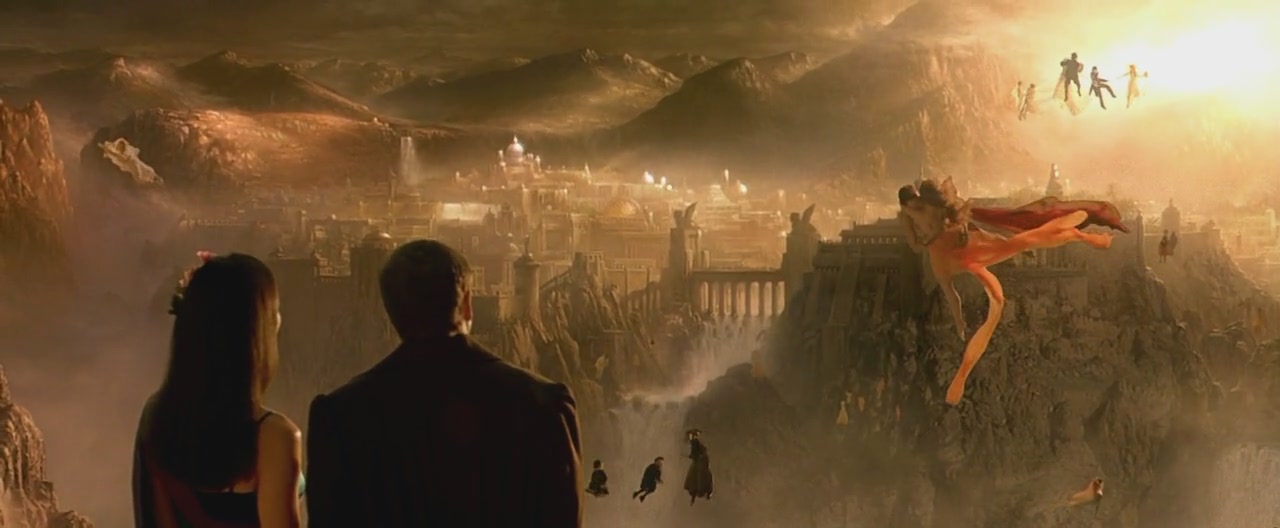
In order to get everyone's head really into the course we began watching What Dreams May Come today.  It's a great film that deals with many issues in an enjoyable way.

Some of the issues include:

  • The meaning of one's life.
  • What happens after you die?
  • Is this world full of fate or do we have free will?
  • What do you do in troubled times?
  • Does what you do in this life affect what happens in the next?


Wednesday, September 4, 2013

DAY 2 - Believers, Questioners, Non-Believers and some BIG Questions

Have YOU found what you're looking for?  First thing we did was ask some questions through Bono and U2's "Still Haven't Found What I'm Looking For".

We separated ourselves into three floor groups: Believers, Non-Believers and Questioners.  The class was more or less equally split.  The discussion that followed was very enjoyable - everyone had the opportunity to ask and answer questions about their own belief systems and many people offered their personal opinions about why they have (or don't have) whatever belief system they have.

We raised, for the first time, some of the "big questions" that most World Religion grapple with, including:

"What happens after you die?"
"Where and how did all this start?"
"What meaning is there to my life?"
"Where do I turn in times of difficulty?"
"Why do you believe or not believe?"
"Why are there people? [such high level thinkers]"?
"Why is there an urge to believe?"
"What about evolution?"
"What started religions?"
"Do things happen for a reason?"


DAY 1 Stephanie's Ponytail

Welcome to World Religions class!  I love teaching this course for many reasons - primarily you are at an age where you are ready to discuss belief systems, where you probably have a well-established set of beliefs yourself and where you are open to thinking about the way you think about things.

Today we read Stephanie's Ponytail, a children's story by Robert Munsch.  Stephanie's new hairstyles were being copied by her classmates and she didn't like this - in the end she got the last laugh.  This is a story about beliefs, opinions and the right of everyone to have their own.